
Multimodal AI: How Businesses Can Use AI Beyond Text
-
Written by

-
Post DateSeptember 10, 2026

Multimodal AI: How Businesses Can Use AI Beyond Text
Modern AI systems can understand and process multiple types of information, including images, documents, audio, video, and text. This allows businesses to build smarter applications that can analyze different types of data and provide more useful insights.
This technology is known as Multimodal AI.
From analyzing documents and product images to understanding customer calls and processing videos, multimodal AI is helping businesses automate tasks that previously required significant manual effort.
What is Multimodal AI?
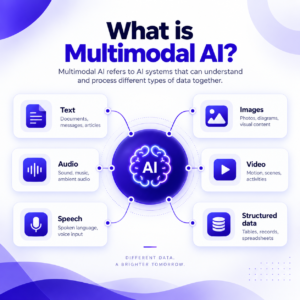
Multimodal AI refers to AI systems that can understand and process different types of data together.
These modalities can include:
- Text
- Images
- Audio
- Video
- Speech
- Structured data
How Does Multimodal AI Work?
Multimodal AI combines different types of information and processes them using AI models.
A simple example can be:
For example, a customer could upload an image of a damaged product and ask:
“What is wrong with this product?”
The AI can analyze the image, understand the customer’s question, and provide an explanation of the possible issue.
Similarly, businesses can combine:
- Documents + Questions
- Images + Descriptions
- Audio + Text
- Video + Questions
- Product Images + Customer Queries
This creates more intelligent AI applications that can understand information from multiple sources.
Why Businesses Need Multimodal AI
Traditional AI applications often work with a single type of input.
However, real-world business information is rarely limited to text.
Businesses work with customer calls, product images, invoices, PDFs, videos, emails, scanned documents, voice messages, and text conversations.
Multimodal AI allows businesses to bring these different types of information together and use AI to analyze and automate complex processes.
This shift has created a growing demand for organizations to Hire AI agent developers who can design, build, and deploy intelligent systems tailored to specific business needs. Whether you’re a startup looking to automate repetitive tasks or an enterprise aiming to optimize complex workflows, AI agents are becoming a critical part of modern business strategy.
Benefits of Multimodal AI
The business landscape is evolving rapidly. Customers expect faster service, employees need better tools, and organizations must continuously improve efficiency to remain competitive.
1. Understand Different Types of Business Data
Businesses generate information in many different formats.
Multimodal AI can analyze text, images, documents, audio, and video instead of relying only on text-based information.
For example, businesses can use AI to:
- Analyze product images
- Extract information from invoices
- Understand customer voice messages
- Analyze recorded meetings
- Process scanned documents
- Answer questions about PDFs
This allows businesses to work with their existing data more effectively.
2. Automate Document Processing
Businesses process thousands of documents every day.
Multimodal AI can help extract and understand information from invoices, receipts, contracts, forms, reports, and scanned PDFs.
For example:
Instead of manually entering invoice information, businesses can automate the complete process and reduce repetitive work.
3. Improve Customer Support
Customers do not always communicate through text.
They may send images, voice messages, screenshots, documents, or videos.
Multimodal AI allows customer support systems to understand these different types of inputs.
For example, a customer can upload a screenshot of an error and ask:
“Why am I getting this error?”
The AI can analyze the screenshot and provide a relevant response.
This can make customer support faster and more effective.
4. Analyze Audio and Voice Conversations
Customer calls contain valuable information, but manually reviewing thousands of calls can take significant time.
Multimodal AI can help businesses:
- Transcribe customer calls
- Summarize conversations
- Identify customer issues
- Detect important topics
- Analyze sentiment
- Extract action items
- Generate call reports
This allows sales and support teams to understand conversations without manually listening to every recording.
5. Analyze Images and Videos
Images and videos contain valuable business information.
Multimodal AI can help analyze visual data for different use cases, including:
- Manufacturing defect detection
- Product inspection
- Retail shelf monitoring
- Vehicle inspection
- Construction site monitoring
- Equipment monitoring
Instead of relying completely on manual inspection, businesses can use AI to assist with visual analysis.
6. Build Smarter AI Assistants
Traditional chatbots mainly work with text.
Multimodal AI allows businesses to build assistants that can understand different types of input.
For example:
A customer could upload a product image, bill, screenshot, document, or voice message.
The AI assistant can analyze the information and provide an appropriate response.
This creates a more natural and intelligent customer experience.
7. Create Multimodal RAG Systems
Businesses are increasingly using Retrieval-Augmented Generation (RAG) systems to allow AI applications to answer questions using company knowledge.
Multimodal AI can take this further by allowing AI systems to work with different types of knowledge.
This can include:
- Text documents
- Product images
- PDFs
- Tables
- Diagrams
- Audio recordings
- Videos
For example, a business could build an AI knowledge assistant that allows employees to ask questions about company documents, images, and other business information.
This can make enterprise knowledge systems more powerful and useful.
Common Multimodal AI Use Cases
Multimodal AI can be applied across different industries and business functions.
Multimodal AI can support healthcare workflows through:
- Medical image analysis
- Patient document processing
- Medical report summarization
- Voice-based assistance
- Healthcare document extraction
AI can combine information from documents, images, and conversations to support healthcare operations.
Financial organizations can use multimodal AI for:
- Invoice processing
- Document verification
- Financial document analysis
- Receipt processing
- Customer support automation
- Report analysis
This can help reduce manual data entry and improve processing efficiency.
Manufacturing businesses can use multimodal AI for:
- Product inspection
- Defect detection
- Equipment monitoring
- Maintenance assistance
- Safety monitoring
- Technical document analysis
Combining visual information with operational data can help businesses improve their manufacturing processes.
Multimodal AI can help support teams analyze:
- Customer messages
- Screenshots
- Voice recordings
- Product images
- Documents
- Videos
This allows support systems to understand customer problems more completely.
Retail businesses can use multimodal AI for:
- Product image analysis
- Visual search
- Customer support
- Product recommendations
- Inventory monitoring
For example, customers could upload an image of a product and ask an AI assistant to identify it or find similar products.
Multimodal AI and AI Agents
Multimodal AI can also be combined with AI agents.
An AI agent can:
- Understand customer messages
- Analyze uploaded images
- Read documents
- Search company knowledge
- Call APIs
- Make decisions
- Trigger workflows
- Complete business tasks
This moves AI beyond simply answering questions toward understanding information and taking action.
Why Businesses Should Invest in Multimodal AI
Multimodal AI can help businesses:
- Reduce manual work
- Process information faster
- Improve customer experiences
- Automate document processing
- Analyze visual and audio data
- Improve decision-making
- Build smarter AI assistants
- Connect AI with business workflows
- Scale operations more efficiently
As businesses generate more information in different formats, the ability to understand and process that information becomes increasingly important.
Why Choose Datumquest for Multimodal AI Solutions?
At Datumquest, we help businesses explore and implement AI and automation solutions designed around their specific business requirements.
Our expertise includes:
- Multimodal AI applications
- AI-powered document processing
- Intelligent chatbots
- AI agents
- Voice AI solutions
- Computer vision systems
- Multimodal RAG systems
- AI-powered automation workflows

By combining AI, automation, data engineering, and analytics, businesses can build intelligent systems that help solve real operational challenges.
Final Thoughts
AI is moving beyond text.
Businesses are now working with documents, images, audio, video, and many other forms of information. Multimodal AI provides a way to understand these different inputs together.
The next generation of AI applications will not simply read and generate text.
They will see, hear, read, understand, reason, and act.
For businesses looking to automate complex processes and build more intelligent applications, multimodal AI can become an important part of their AI strategy.
Ready to Build Smarter AI Solutions?
From intelligent document processing and AI assistants to multimodal RAG, voice AI, and AI-powered automation, Datumquest can help businesses explore practical AI solutions designed around their real business needs.