



Home / Portfolio / Case Study / Data Engineers /

Global POS Sales Analysis Sales Analysis Dashboard

Overview

Tech Stack

Databricks

Cloud Storage

Google Sheets

Azure

Industry

E-Commerce

Region

New York City

Project Size

Non-Disclosable

Client Need

The client required a modern data platform to centralize data, automate processing, and provide accurate real-time insights. It also needed to scale efficiently while ensuring security, reliability, and consistent reporting.

Why Choose Us

Expertise in Azure cloud architecture

Leveraging Microsoft Azure services, we build reliable architectures that ensure availability, performance, and seamless integration with enterprise applications.

Cloud-Native Data Platforms

We build cloud-based platforms that remove on-premise limitations and enable flexible, anywhere access.

Secure & Optimized Data Platform

Security, governance, and performance optimization are built into every deployment.

Distributed data processing for scalability

We implement distributed processing frameworks that handle large data volumes efficiently, enabling fast processing, real-time analytics, and smooth scaling as data grows.

The Challenges

01

Data was stored in multiple raw CSV files across systems, making it difficult to manage and analyze efficiently.

02

The absence of a unified data warehouse prevented consistent reporting and consolidated data access.

03

Teams spent significant time manually organizing, cleaning, and preparing raw data files.

04

The existing infrastructure lacked the flexibility to scale with increasing data and business demands.

Core Feature

AI automation that tracks orders and syncs customer and inventory data in real time.

The Core Challenge
Was Not Just Data Volume

it was data fragmentation and lack of structure, as information was scattered across multiple CSV files and systems, making it difficult to organize, process efficiently, and generate reliable business insights.

Business-Critical Data Challenges Identified
DatumQuest identified the need for

Project Timeline

1/5

Discovery & Data Assessment

At the beginning of the project, we studied the company’s order handling, customer support process, and inventory management workflow. The business relied heavily on manual monitoring and multiple disconnected tools, which caused delays in identifying order issues and slow response to customer queries. Based on this, we identified the need for a centralized automated system.

Key Activities:

2/5

Architecture Design

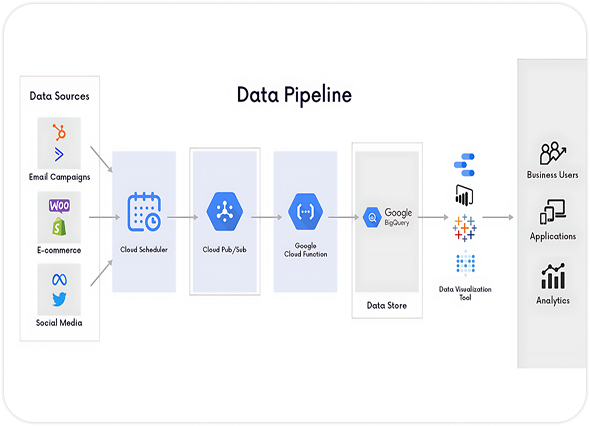
After analysis, we designed the system architecture and prepared integrations between the store, inventory, database, and communication tools. The objective was to create a smooth data flow so every system could communicate automatically without manual updates.

Key Activities:

3/5

Data Ingestion & Transformation

We developed automated workflows to monitor orders in real time and detect fulfillment delays. The system was configured to automatically track order status, trigger alerts, and retrieve order history instantly when required.

Key Activities:

4/5

Cloud Migration & Optimization

Customer data processing and AI-based analysis were implemented to improve support efficiency. The system validated customer information, centralized records, and analyzed customer calls to identify issues and patterns.

Key Activities:

5/5

Performance & Validation

The complete solution was tested to ensure accurate order tracking, inventory sync, and alert functionality. After deployment, performance monitoring and optimizations were performed to ensure stable daily operations.

Key Activities:

How Datumquest is Making an Impact

Image
Michael Carter
E-commerce Manager

Datumquest specializes in AI, automation, data science, and analytics, helping businesses unlock data-driven insights and streamline operations.

Newsletter

Email

© 2025 Datumquest. All rights reserved. A Thinkwik Company.