Mapped the screenplay-to-video pipeline, defined system architecture, and planned each stage from script ingestion to delivery. Established modular workflows and clear data flow for scalability and maintainability.

Back
Home / Portfolio / Case Study / Generative AI /
CineForge AI
An event-driven pipeline that turns a written screenplay into a finished, continuity-locked cinematic film: casting, rendering, voice, score and final edit, with no one in the chair.
Industry
Media & Entertainment
Region
Global
Project Size
Non-Disclosable
Overview
Generative video models can produce a stunning ten-second clip, but a film is not one clip, it is dozens of them that must look like the same world, the same characters, and the same story. Most pipelines break exactly there: faces drift, wardrobes change, lighting jumps, and a single model outage stalls the entire job.
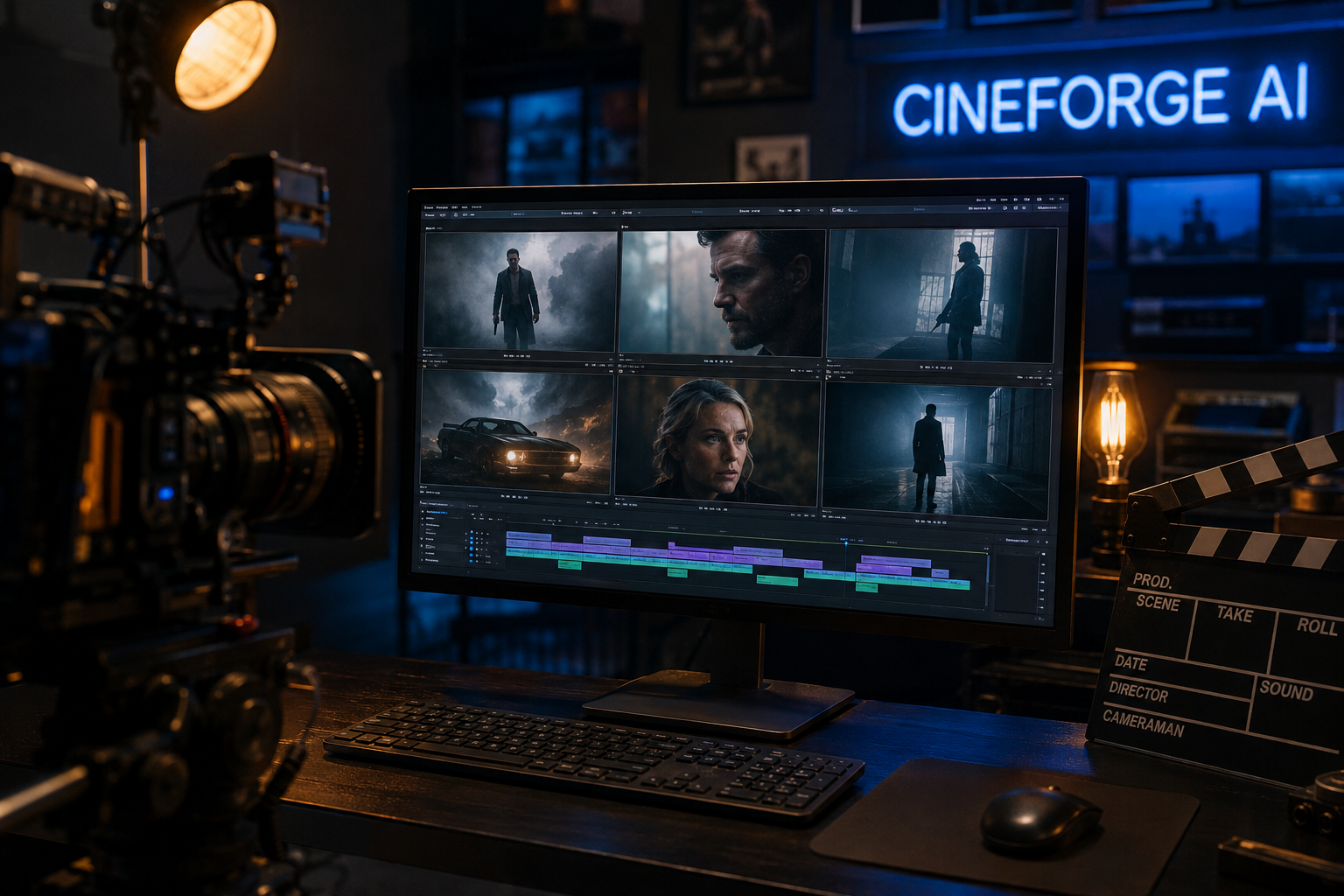
Datumquest designed and built CineForge AI for Cinematic Moments: an autonomous, event-driven engine that ingests a raw screenplay and returns a complete cinematic video. It reads the script, casts and renders consistent characters, reasons about visual continuity before a frame is generated, produces every shot across a fleet of AI video models, layers in voice, score and lip-sync, then stitches the final cut, all without a human touching a timeline.
The result is a system where continuity is engineered, not hoped for, and where no single model vendor is ever a point of failure.
Core Feature
AI-powered cinematic video generation engine that transforms raw screenplays into complete, consistent, and polished cinematic videos automatically.
- Automated Screenplay Analysis And Scene Breakdown
- Consistent Character Casting, Wardrobe, Lighting, And Visual Style
- Continuity Planning Before Every Shot Is Generated
- Multi-Model Video Generation With Backup Model Routing
- AI Voiceover, Background Score, Lip-Sync, And Audio Alignment
- Final Video Stitching Into A Complete Cinematic Output
Technology Stack
Our MLOps engineers work with Kubeflow, MLflow, and Airflow for orchestration; Seldon Core and Triton for inference; Feast and Tecton for feature stores; Prometheus and Grafana for monitoring. We deploy on AWS SageMaker, GCP Vertex AI, and Azure ML while maintaining vendor-agnostic portability.
Outcomes
Delivered a complete screenplay-to-video pipeline with fully autonomous production.
Maintained consistent characters, wardrobe, lighting, and visual style across every generated shot.
Automated scene planning, video, audio, lip-sync, and stitching to cut manual editing.
Improved production reliability through multi-model video generation with automatic fallback routing.
Prevented wasted renders by making every production phase resumable and fault-tolerant.
Enabled faster cinematic content creation without depending on a single AI model vendor.
The Challenges
01
Visual drift between shots
Each clip is generated independently, and without intervention, a character’s face, hair and wardrobe mutate from shot to shot, breaking the illusion of a single film.
No single reliable model
Every video API has different strengths, rate limits, outages and pricing. Betting an entire product on one vendor was untenable.
02
Clips are short, films are long
State-of-the-art models cap at roughly ten seconds per generation. A multi-minute story needs many shots, seamlessly joined and consistently graded.
03
Runaway cost & fragile long jobs
Naively calling premium APIs for every shot makes each film uneconomical, and a ten-phase render that dies at phase eight cannot start over from zero.
04
Solution by Datumquest

Built a continuity engine to lock characters, wardrobe, lighting, and visual style before video generation.
Used a multi-model rendering system with automatic fallback to prevent failed or delayed video generation.
Split the screenplay into clean, model-ready scenes and shots for smoother cinematic output.
Added automated voice, background score, lip-sync, and final video assembly for a complete finished cut.
Futuristic Cityscape Created with CineForge AI
A cinematic AI-generated cityscape video showing a glowing night skyline with neon-lit towers, modern buildings, and waterfront reflections. The video highlights CineForge AI’s ability to create realistic, visually rich, and polished cinematic scenes from a simple creative prompt.
Project Roadmap
Project Timeline
A clear 6-week process from discovery and architecture to continuity, rendering, audio, self-hosting, hardening, and final launch.
01
WEEK 1
Discovery & Architecture
1st Week
02
WEEK 2
Continuity Engine
2nd Week
03
WEEK 3
Multi-Model Rendering
3rd Week
04
WEEK 4
Audio & Lip-Sync
4th Week
05
WEEK 5
Self-Hosting & Cost
5th Week
06
WEEK 6
Hardening & Launch
6th Week
Discovery & Architecture
Key Activities
- Stakeholder workshops and framing of the continuity problem
- Selected an event-driven Temporal + Kafka backbone
- Defined the ten-phase pipeline contract and success criteria
- Data model design across PostgreSQL and MongoDB
Continuity Engine
Built a reasoning layer to maintain consistency in characters, wardrobe, lighting, and scenes. Implemented tracking and memory-based logic to ensure coherence across sequences.
Key Activities
- Character extraction from raw screenplay text
- Opus cross-model reasoning producing per-shot directives
- Continuity-bible generation with Claude extended thinking
- FLUX.2 character portrait anchors as visual ground truth
Multi-Model Rendering
Integrated multiple AI video models with smart routing and fallback support. Designed dynamic model selection to ensure reliability and consistent output quality.
Key Activities
- Genre classifier and specialised beat chunkers
- Health-aware provider waterfall across five-plus backends
- Model-specific prompt variants for consistent output
- Final-cut stitching into seamless long-form video
Audio & Lip-Sync
Added automated voiceover, background score, and lip-sync processing. Ensured proper synchronization between audio and visuals for a cinematic experience.
Key Activities
- Expressive voiceover via Hume Octave with emotional direction
- Generative score with MusicGen
- LatentSync lip-sync application per shot
- Automated SyncNet verification of mouth alignment
Self-Hosting & Cost Optimization
Deployed self-hosted infrastructure to reduce API dependency and optimize costs. Improved performance through resource optimization and caching strategies.
Key Activities
- Deployed LTX-2.3 22B on RunPod serverless A100 GPUs
- Two-tier render waterfall with automatic failover
- Credit estimator pricing each job before it runs
- Ledger-based resumability to eliminate wasted renders
Hardening, Migration & Launch
Enhanced reliability, migrated storage to Cloudflare R2, and prepared for production launch. Strengthened security, added monitoring, and ensured stable deployment.
Key Activities
- Moved all storage to Cloudflare R2 using a storage-factory layer.
- Removed all hard-coded credentials.
- Observability via Prometheus, Grafana and structured logging
- Real-time React/TypeScript debugger and production launch
Datumquest specializes in AI, automation, data science, and analytics, helping businesses unlock data-driven insights and streamline operations.
Company
Services
Newsletter
© 2025 Datumquest. All rights reserved. A Thinkwik Company.